Friday, May 01, 2009

Today In Useless Info: 'Oyster Crackers'


'Oyster crackers are small, salted, buttery crackers, typically hexagons about 0.59 in (15 mm) in diameter, although a slightly larger circular variety is also prevalent. They are popular in the northeastern USA, where they are served as an accompaniment to soup, and in the Cincinnati area, where they are frequently served with the city's distinctive chili.

In New England oyster crackers are served in oyster stew and chowders. Oyster crackers do not contain oysters. The origin of the name is unclear, but it may be that they were originally served with oyster stew or clam chowder or merely that their form (a vaguely round 'shell' that splits evenly into two parts) was suggestive of the shape of an oyster in its shell. According to the web site of the still-extant bakery discussed below, the crackers were so named because they were commonly served with oyster stew and other oyster dishes (at least on their early packages).

The oyster cracker was invented by Adam Exton, a baker in Trenton, New Jersey. He emigrated to America from Lancashire, England in 1842. [1] In Trenton, Exton opened a cake and cracker bakery with his brother-in-law, Richard Aspden in 1846. Although Aspden died the following year, Exton continued with the bakery (named the Exton Cracker Bakery or Adam Exton & Co.). He invented the oyster cracker along with a machine that rolled and docked pastry and solved the sanitary problems of hand-rolling crackers.

His oyster cracker was so popular that competitor bakeries "borrowed" his recipe and began producing them as well.

Westminster crackers still makes oyster crackers.

They are known for their tiny appearance. Also, they have a taste similar to saltine crackers.'

Labels: , , ,

Tuesday, February 10, 2009

Interesting...


'But the truth is that until very late in his presidency, Lincoln was deeply conflicted about whether to liberate the slaves, how to liberate the slaves and what to do with them once they had been liberated.

Whereas abolition was a central aspect of Lincoln’s moral compass, racial equality was not. In fact, Lincoln wrestled with three distinct but sometimes overlapping discourses related to race: slavery, equality and colonization.

Isolating these three—like the three strands of a braid of hair—helps us to understand how conflicted the man was about African Americans and their place in this country.

Interspersed among these three discourses is the manner in which Lincoln seems to have wrestled with his own use of the “N-word.” Lincoln used the word far less than did Stephen Douglas, his Democratic challenger for the U.S. Senate, but he did indeed use it in prominent contexts including debates and public speeches.

Even as late as April 1862, James Redpath recorded Lincoln’s saying of President Fabre Nicholas Geffard of Haiti (who had offered to send a white man as his ambassador to the United States), “You can tell the President of Hayti that I shan’t tear my shirt if he sends a nigger here!”

Lincoln despised slavery as an institution, an economic institution that discriminated against white men who couldn’t afford to own slaves and, thus, could not profit from the advantage in the marketplace that slaves provided.

At the same time, however, he was deeply ambivalent about the status of black people vis-à-vis white people, having fundamental doubts about their innate intelligence and their capacity to fight nobly with guns against white men in the initial years of the Civil War.

Even as he was writing the Emancipation Proclamation during the summer of 1862, Lincoln was working feverishly to ship all those slaves he was about to free out of the United States.

So taken was he with the concept of colonization that he invited five black men to the White House and offered them funding to found a black republic in Panama, for the slaves he was about to free. Earlier, he had advocated that the slaves be freed and shipped to Liberia or Haiti.

And just one month before the Emancipation became the law of the land, in his Annual Message to Congress on Dec. 1, 1862, Lincoln proposed a constitutional amendment that would “appropriate money, and otherwise provide, for colonizing free colored persons with their own consent, at any place or places without the United States.”

Full article here.

Labels: , ,

Friday, January 16, 2009

Today In - 'Useless Info'


Tea’s Wonderful History

'Tea is among the world’s oldest and most revered beverages.

It is today’s most popular beverage in the world, next to water.

According to Chinese legend, tea was invented accidentally by the Chinese Emperor Shen Nong in 2737 B.C. Emperor Shen Nong was a scholar and herbalist, as well as a creative scientist and patron of the arts.

Among other things, the emperor believed that drinking boiled water contributed to good health.

By his decree, his subjects and servants had to boil their water before drinking it as a hygiene precaution.

On one summer day while he was visiting a distant region, he and his entourage stopped to rest.

The servants began to boil water for the skilled ruler and his subjects to drink.

Dried leaves from a nearby camellia bush fell into the boiling water.

The emperor was interested in the new liquid because it had a pleasing aroma in this new brew interested the emperor, so he drank the infusion and discovered that it was very refreshing and had a delightful flavor.

He declared that tea gives vigor to the body, thus.

That was when tea was invented, but it was considered as a medicinal beverage.

It was around 300 A.D. when, tea became a daily drink.

It was not until the Tang and Song Dynasties when tea showed some significance in Chinese tradition.

During the mid-Tang Dynasty (780 A.D.), a scholar named Lu Yu published the first definitive book, Cha Ching or The Tea Classic, on tea after he spent over twenty years studying the subject.

This documentation included his knowledge of planting, processing, tasting, and brewing tea. His research helped to elevate tea drinking to a high status throughout China.

This was when the art of tea drinking was born.

Later, a Song Dynasty emperor helped the spread of tea consumption further by indulging in this wonderful custom.

He enjoyed tea drinking so much, that he bestowed tea as gifts only to those who were worthy.

During this e same time, tea was the inspirationinspired many of books, poems, songs, and paintings.

This not only popularized tea, it also elevated tea’s value which drew tea-growers to the capital.

Between the Yuan and Qing Dynasties, the technology of tea production continuously advanced to become more simplified and to improve the methods of enhancing tea flavor.

During this period, tea houses and other tea-drinking establishments were opening up all over China.

By 900 A.D., tea drinking spread from China to Japan where the Japanese Tea Ceremony or Chanoyu, was created.

In Japan, tea was elevated to an art form which requires years of dedicated studying. Unlike the Japanese people, the Chinese people tend to view tea drinking as a form of enjoyment: to have after a meal or to serve when guests visit.

Tea was introduced to Europe in the 1600s; it was introduced to England in 1669.

At that time, the drink was enjoyed only by the aristocracy because a pound of tea cost an average British laborer the equivalent of nine months in wages.

The British began to import tea in larger qualities to satisfy the rapidly expanding market.

Tea became Britain’s most important item of trade from China.

All classes were able to drink tea as the tea trade increased and became less of a luxury.

The word “tea” was derived from ancient Chinese dialects.

Such words as “Tchai,” “"Cha,” and “Tay” were used to describe the tea leaf as well as the beverage.

The tea plant’s scientific name is Camellia sinensis (which is from the The aceae family of the Theales order), and it is indigenous to China and parts of India.

The tea plant is an evergreen shrub that develops fragrant white, five-petaled flowers, and; it is related to the magnolia.

Tea is made from young leaves and leaf buds from the tea tree.

Two main varieties are cultivated: C. sinensis sinensis, a Chinese plant with small leaves, and C. sinensis assamica, an Indian plant with large leaves. Hybrids of these two varieties are also cultivated.

What we call “herbal tea” is technically not tea because it does not come from the tea plant but consists a mixture of flowers, fruit, herbs or spices from other plants.'

Labels: , , ,

Tuesday, July 29, 2008

Today's Number 1's


THE 2000s

2008 ... "I Kissed a Girl" by Katy Perry
2007 ... "Hey There Delilah" by Plain White T's
2006 ... "Promiscuous" by Nelly Furtado featuring Timbaland
2005 ... "We Belong Together" by Mariah Carey
2004 ... "Confessions Part II" by Usher
2003 ... "Crazy in Love" by Beyoncé featuring Jay-Z
2002 ... "Hot in Herre" by Nelly
2001 ... "Bootylicious" by Destiny's Child
2000 ... "It's Gonna Be Me" by 'N Sync

THE 1990s

1999 ... "Genie in a Bottle" by Christina Aguilera
1998 ... "The Boy Is Mine" by Brandy & Monica
1997 ... "I'll Be Missing You" by Puff Daddy & Faith Evans featuring 112
1996 ... "Macarena [Bayside Boys Mix]" by Los Del Rio
1995 ... "Waterfalls" by TLC
1994 ... "I Swear" by All-4-One
1993 ... "Can't Help Falling in Love" by UB40
1992 ... "Baby Got Back" by Sir Mix-a-Lot
1991 ... "(Everything I Do) I Do It for You" by Bryan Adams
1990 ... "Vision of Love" by Mariah Carey

THE 1980s

1989 ... "Toy Soldiers" by Martika
1988 ... "Roll with It" by Steve Winwood
1987 ... "Shakedown" by Bob Seger
1986 ... "Glory of Love" by Peter Cetera
1985 ... "Shout" by Tears for Fears
1984 ... "When Doves Cry" by Prince
1983 ... "Every Breath You Take" by The Police
1982 ... "Eye of the Tiger" by Survivor
1981 ... "Jessie's Girl" by Rick Springfield
1980 ... "Magic" by Olivia Newton-John

THE 1970s

1979 ... "Bad Girls" by Donna Summer
1978 ... "Shadow Dancing" by Andy Gibb
1977 ... "I Just Want to Be Your Everything" by Andy Gibb
1976 ... "Kiss and Say Goodbye" by The Manhattans
1975 ... "One of These Nights" by The Eagles
1974 ... "Annie's Song" by John Denver
1973 ... "The Morning After" by Maureen McGovern
1972 ... "Alone Again (Naturally)" by Gilbert O'Sullivan
1971 ... "You've Got a Friend" by James Taylor
1970 ... "(They Long to Be) Close to You" by The Carpenters

THE 1960s

1969 ... "In the Year 2525 (Exordium & Terminus)" by Zager & Evans
1968 ... "Hello, I Love You" by The Doors
1967 ... "Light My Fire" by The Doors
1966 ... "Wild Thing" by The Troggs
1965 ... "(I Can't Get No) Satisfaction" by The Rolling Stones
1964 ... "A Hard Day's Night" by The Beatles
1963 ... "So Much in Love" by The Tymes
1962 ... "Roses Are Red" by Bobby Vinton
1961 ... "Tossin' and Turnin'" by Bobby Lewis
1960 ... "I'm Sorry" by Brenda Lee

THE 1950s

1959 ... "Lonely Boy" by Paul Anka
1958 ... "Poor Little Fool" by Ricky Nelson
1957 ... "Teddy Bear" by Elvis Presley
1956 ... "My Prayer" by The Platters
1955 ... "Rock Around the Clock" by Bill Haley & His Comets
1954 ... "Little Things Mean a Lot" by Kitty Kallen
1953 ... "I'm Walking Behind You" by Eddie Fisher
1952 ... "Auf Wiederseh'n Sweetheart" by Vera Lynn
1951 ... "Come On-a My House" by Rosemary Clooney
1950 ... "Mona Lisa" by Nat "King" Cole

THE 1940s

1949 ... "Some Enchanted Evening" by Perry Como
1948 ... "Woody Wood-Pecker" by Kay Kyser
1947 ... "Peg O' My Heart" by The Harmonicats
1946 ... "Surrender" by Perry Como
1945 ... "On the Atchison, Topeka and Santa Fe" by Johnny Mercer
1944 ... "I'll Be Seeing You" by Bing Crosby
1943 ... "You'll Never Know" by Dick Haymes
1942 ... "Jingle Jangle Jingle" by Kay Kyser
1941 ... "Daddy" by Sammy Kaye
1940 ... "I'll Never Smile Again" by Tommy Dorsey

THE 1930s

1939 ... "Stairway to the Stars" by Glenn Miller
1938 ... "Music, Maestro, Please" by Tommy Dorsey
1937 ... "Gone with the Wind" by Horace Heidt
1936 ... "It's a Sin to Tell a Lie" by Fats Waller
1935 ... "Rhythm Is Our Business" by Jimmie Lunceford
1934 ... "The Very Thought of You" by Ray Noble
1933 ... "Lazybones" by Ted Lewis
1932 ... "In a Shanty in Old Shanty Town" by Ted Lewis
1931 ... "At Your Command" by Bing Crosby
1930 ... "Dancing with Tears in My Eyes" by Nat Shilkret

THE 1920s

1929 ... "Pagan Love Song" by Copley Plaza Orchestra (Bob Haring)
1928 ... "My Angel" by Paul Whiteman
1927 ... "Two Black Crows-Parts 1 & 2 (The Early Bird Catches the Worm)" by Moran & Mack
1926 ... "Valencia" by Paul Whiteman
1925 ... "If You Knew Susie" by Eddie Cantor
1924 ... "What'll I Do?" by Paul Whiteman
1923 ... "Down Hearted Blues" by Bessie Smith
1922 ... "Stumbling" by Paul Whiteman
1921 ... "Cherie" by Paul Whiteman
1920 ... "When My Baby Smiles at Me" by Ted Lewis & His Band

THE 1910s

1919 ... "Beautiful Ohio" by Henry Burr
1918 ... "Hello Central, Give Me No Man's Land" by Al Jolson
1917 ... "Oh Johnny, Oh Johnny, Oh!" by American Quartet
1916 ... "There's a Quaker Down in Quaker Town" by Henry Burr & Albert Campbell
1915 ... "Home, Sweet Home" by Alice Nielsen
1914 ... "By the Beautiful Sea" by Heidelberg Quintet
1913 ... "When Irish Eyes Are Smiling" by Chauncey Olcott
1912 ... "Ragging the Baby to Sleep" by Al Jolson
1911 ... "I'm Falling in Love with Someone" by John McCormack
1910 ... "Casey Jones" by Billy Murray & American Quartet

THE 1900s

1909 ... "To the End of the World" by Henry Burr
1908 ... "Are You Sincere?" by Elise Stevenson
1907 ... "Nobody's Little Girl" by Byron G. Harlan
1906 ... "Nobody" by Bert Williams
1905 ... "Give My Regards to Broadway" by Billy Murray
1904 ... "Meet Me in St. Louis, Louis" by Billy Murray
1903 ... "Come Down, Ma Ev'ning Star" by Henry Burr
1902 ... "Bill Bailey, Won't You Please Come Home" by Arthur Collins
1901 ... "Jim Lawson's Horse Trade with Deacon Witherspoon" by Cal Stewart
1900 ... "Ma Tiger Lily" by Len Spencer

THE 1890s

1899 ... "My Wild Irish Rose" by Albert Campbell
1898 ... "She Was Bred in Old Kentucky" by George J. Gaskin
1897 ... "The Stars and Stripes Forever" by Sousa's Band
1896 ... "Just Tell Them That You Saw Me" by J.W. Myers
1895 ... "Washington Post March" by Sousa's Band
1894 ... "We Were Sweethearts, Nell and I" by George J. Gaskin
1893 ... "Mamie, Come and Kiss Your Honey Boy" by Len Spencer
1892 ... "Michael Casey at the Telephone" by Russell Hunting
1891 ... "The Whistling Coon" by George Washington Johnson
1890 ... "Semper Fidelis" by U.S. Marine Band

Labels: , ,

Thursday, March 20, 2008

Who invented sausage?


'Sausage is a logical outcome of efficient butchery. Sausage-makers put to use meat and animal parts that are edible and nutritious, but not particularly appealing, such as scraps, organ meats, blood, and fat, and that allow the preservation of meat that can not be consumed immediately. These were typically salted and stuffed into a tubular casing made from the cleaned intestine of the animal producing the characteristic cylindrical shape. Hence, sausages, puddings and salami are amongst the oldest of prepared foods, whether cooked and eaten immediately or dried to varying degrees.


It is often assumed that sausages were invented by Sumerians in what is Iraq today, around 3000 BC. Chinese sausage làcháng (臘腸/腊肠), which consisted of goat and lamb meat, was first mentioned in 589 BC. Homer, the poet of Ancient Greece, mentioned a kind of blood sausage in the Odyssey (book 20, verse 25), and Epicharmus (ca. 550 BC – ca. 460 BC) wrote a comedy titled The Sausage. Evidence suggests that sausages were already popular both among the ancient Greeks and Romans, and most likely with the non-literate tribes occupying the larger part of Europe.

During the reign of the Roman emperor Nero, sausages were associated with the Lupercalia festival. The early Catholic Church outlawed the Lupercalia Festival and made eating sausage a sin. For this reason, the Roman emperor Constantine banned the eating of sausages. Early in the 10th century in the Byzantine Empire, Leo VI the Wise outlawed the production of blood sausages following cases of food poisoning.

Traditionally, sausage casings were made of the cleaned intestines (or stomachs in the case of haggis and other traditional puddings) of animals. Today, however, natural casings are often replaced by collagen, cellulose or even plastic casings, especially in the case of industrially manufactured sausages. Additionally, luncheon meat (such as Spam) and sausage meat are now available without casings in tins and jars.

The most basic sausage consists of meat cut into pieces or ground and filled into a casing such as an animal intestine. The meat may be from any animal, but traditionally is pork, beef or veal. The meat/fat ratio is dependent upon the style and producer, but in the United States, fat content is legally limited to a maximum of 30%, 35% or 50%, by weight, depending on the style. The USDA defines the content for various sausages and generally prohibits fillers and extenders.[1] Most traditional styles of sausage from Europe and Asia use no bread-based filler and are 100% meat and fat (excluding salt and other flavorings, such as herbs).[2] In the UK and other countries with English cooking traditions, bread and starch-based fillers account for up to 25% of ingredients. The filler used in many sausages helps them to keep their shape as they are cooked. As the meat contracts in the heat so the filler expands.

The word sausage is derived from Old French saussiche, from the Latin word salsus, meaning salted.'

Saucisse

If this is the case, how come I haven't come across an Chinese/Asian sausages in contemporary cuisine?


Labels: , ,

Wednesday, March 19, 2008

Today's Number 1's


THE 2000s

2008 ... "Love in This Club" by Usher featuring Young Jeezy
2007 ... "Glamorous" by Fergie featuring Ludacris
2006 ... "So Sick" by Ne-Yo
2005 ... "Candy Shop" by 50 Cent featuring Olivia
2004 ... "Yeah!" by Usher featuring Ludacris & Lil Jon
2003 ... "In Da Club" by 50 Cent
2002 ... "Ain't It Funny" by Jennifer Lopez featuring Ja Rule
2001 ... "Butterfly" by Crazy Town
2000 ... "Say My Name" by Destiny's Child

THE 1990s

1999 ... "Believe" by Cher
1998 ... "Gettin' Jiggy Wit It" by Will Smith
1997 ... "Can't Nobody Hold Me Down" by Puff Daddy featuring Ma$e
1996 ... "Because You Loved Me" by Celine Dion
1995 ... "Take a Bow" by Madonna
1994 ... "The Sign" by Ace of Base
1993 ... "Informer" by Snow
1992 ... "Save the Best for Last" by Vanessa Williams
1991 ... "One More Try" by Timmy T.
1990 ... "Black Velvet" by Alannah Myles

THE 1980s

1989 ... "The Living Years" by Mike + the Mechanics
1988 ... "Never Gonna Give You Up" by Rick Astley
1987 ... "Lean on Me" by Club Nouveau
1986 ... "These Dreams" by Heart
1985 ... "Can't Fight This Feeling" by REO Speedwagon
1984 ... "Jump" by Van Halen
1983 ... "Billie Jean" by Michael Jackson
1982 ... "I Love Rock 'n Roll" by Joan Jett & the Blackhearts
1981 ... "Keep On Loving You" by REO Speedwagon
1980 ... "Another Brick in the Wall" by Pink Floyd

THE 1970s

1979 ... "Tragedy" by The Bee Gees
1978 ... "Night Fever" by The Bee Gees
1977 ... "Love Theme from 'A Star Is Born' (Evergreen)" by Barbra Streisand
1976 ... "December 1963 (Oh, What a Night)" by The Four Seasons
1975 ... "My Eyes Adored You" by Frankie Valli
1974 ... "Dark Lady" by Cher
1973 ... "Love Train" by The O'Jays
1972 ... "A Horse with No Name" by America
1971 ... "Me and Bobby McGee" by Janis Joplin
1970 ... "Bridge Over Troubled Water" by Simon & Garfunkel

THE 1960s

1969 ... "Dizzy" by Tommy Roe
1968 ... "(Sittin' on) the Dock of the Bay" by Otis Redding
1967 ... "Happy Together" by The Turtles
1966 ... "The Ballad of the Green Berets" by S/Sgt. Barry Sadler
1965 ... "Eight Days a Week" by The Beatles
1964 ... "She Loves You" by The Beatles
1963 ... "Our Day Will Come" by Ruby & the Romantics
1962 ... "Hey! Baby" by Bruce Channel
1961 ... "Surrender" by Elvis Presley
1960 ... "Theme from 'A Summer Place'" by Percy Faith

THE 1950s

1959 ... "Venus" by Frankie Avalon
1958 ... "Tequila" by The Champs
1957 ... "Young Love" by Tab Hunter
1956 ... "Poor People of Paris" by Les Baxter
1955 ... "Sincerely" by The McGuire Sisters
1954 ... "Secret Love" by Doris Day
1953 ... "The Doggie in the Window" by Patti Page
1952 ... "Wheel of Fortune" by Kay Starr
1951 ... "If" by Perry Como
1950 ... "Music! Music! Music!" by Teresa Brewer

THE 1940s

1949 ... "Cruising Down the River" by Blue Barron
1948 ... "Mañana (Is Soon Enough for Me)" by Peggy Lee
1947 ... "Heartaches" by Ted Weems
1946 ... "Oh! What It Seemed to Be" by Frankie Carle
1945 ... "Rum and Coca-Cola" by The Andrews Sisters
1944 ... "Besame Mucho (Kiss Me Much)" by Jimmy Dorsey
1943 ... "I've Heard That Song Before" by Harry James
1942 ... "Moonlight Cocktail" by Glenn Miller
1941 ... "Frenesi" by Artie Shaw
1940 ... "In the Mood" by Glenn Miller

THE 1930s

1939 ... "Deep Purple" by Larry Clinton
1938 ... "Ti-Pi-Tin" by Horace Heidt
1937 ... "This Year's Kisses" by Hal Kemp
1936 ... "Lights Out" by Eddy Duchin
1935 ... "Lovely to Look At" by Eddy Duchin
1934 ... "Let's Fall in Love" by Eddy Duchin
1933 ... "You're Getting to Be a Habit with Me" by Bing Crosby
1932 ... "Too Many Tears" by Guy Lombardo
1931 ... "By the River St. Marie" by Guy Lombardo
1930 ... "Stein Song (University of Maine)" by Rudy Vallee

THE 1920s

1929 ... "A Precious Little Thing Called Love" by George Olsen
1928 ... "Among My Souvenirs" by Paul Whiteman
1927 ... "Some of These Days" by Sophie Tucker with Ted Lewis & His Band
1926 ... "Who?" by George Olsen
1925 ... "All Alone" by John McCormack
1924 ... "Linger Awhile" by Paul Whiteman
1923 ... "Carolina in the Morning" by Van & Schenk
1922 ... "My Man" by Fanny Brice
1921 ... "Margie" by Eddie Cantor
1920 ... "Dardanella" by Ben Selvin's Novelty Orchestra

THE 1910s

1919 ... "Till We Meet Again" by Henry Burr & Albert Campbell
1918 ... "Hail! Hail! The Gang's All Here" by Irving Kaufman & Columbia Quartet
1917 ... "Poor Butterfly" by Victor Military Band
1916 ... "M-O-T-H-E-R (A Word That Means the World to Me)" by Henry Burr
1915 ... "Chinatown, My Chinatown" by American Quartet
1914 ... "I'm on My Way to Mandalay" by Henry Burr, Albert Campbell & Will Oakland
1913 ... "When the Midnight Choo Choo Leaves for Alabam'" by Arthur Collins & Byron Harlan
1912 ... "Moonlight Bay" by American Quartet
1911 ... "Mother Machree" by Will Oakland
1910 ... "Where the River Shannon Flows" by Harry MacDonough

THE 1900s

1909 ... "The Right Church, but the Wrong Pew" by Arthur Collins & Byron Harlan
1908 ... "As Long as the World Rolls On" by Alan Turner
1907 ... "My Gal Sal" by Byron G. Harlan
1906 ... "Wait Till the Sun Shines, Nellie" by Byron G. Harlan
1905 ... "Yankee Doodle Boy" by Billy Murray
1904 ... "Silver Threads Among the Gold" by Richard Jose
1903 ... "Come Down, Ma Evening Star" by Mina Hickman
1902 ... "Arkansaw Traveler" by Len Spencer
1901 ... "When Reuben Comes to Town" by S.H. Dudley
1900 ... "When Cloe Sings a Song" by George J. Gaskin

THE 1890s

1899 ... "When You Ain't Got No More Money, Well, You Needn't Come Around" by Arthur Collins
1898 ... "My Old Kentucky Home" by Edison Male Quartette
1897 ... "My Gal Is a Highborn Lady" by Len Spencer
1896 ... "My Best Girl's a New Yorker" by Edward M. Favor
1895 ... "The Sidewalks of New York" by Dan Quinn
1894 ... "The Liberty Bell" by U.S. Marine Band
1893 ... "O Promise Me" by George J. Gaskin
1892 ... "Ta-Ra-Ra-Boom Der E" by Len Spencer
1891 ... "Little 'Liza Loves You" by Len Spencer

Number One In History

Labels: , , ,

Monday, January 14, 2008

Brick House


[Click image to enlarge]

When Denver was still a lawless cowboy/mining town full of trouble, it was constantly catching fire and burning down.

Eventually, they passed a law that any new buildings were required to be built in brick.

In the 60's and 70's, much of downtown was razed for shiny new glass and metal boxes [bad idea].

The area now known as LoDo, was pretty much a hobo-wasteland with abandoned buildings and rail cars.

But thanks to urban redevelopment, it is now yuppie central - home to some of the most expensive real estate in Denver.


Labels: , , , , ,

Sunday, November 25, 2007

Question...


I came across The History Of Rock And Roll over the weekend, and they mentioned the 'Lollapalooza Generation', and it got me to think, were/are we really a generation/movement?

We have sinced moved in to the workforce and are taking the place of our Baby Boomer parents, and older sibllings.

Did our older siblings get a name, because I know we were labeled as Gen X'ers.

So what's your thoughts?

Are we a cultural force?

What changes have we made in popular culture?

Discuss.


Labels: , ,

Wednesday, August 22, 2007

Cold War, what's that?


Plus, 'The Simpsons' has always been on the air, and they grew up with 'Friends'.

College knowledge relegates more to history


What’s the Berlin Wall? Incoming freshmen grew up after the Cold War

BELOIT, Wis. - The Berlin Wall? What Berlin Wall?

'The class of students entering college this month is the first post-Cold War class, according to the Beloit College Mindset List, a compilation of the events, technology, people and social trends that shaped the incoming crop of freshmen.

To them, it’s always been normal for Russia to have multiple political parties and U.S. rock bands to stop in Moscow on their tours, according to the list released Tuesday by the private school in this city that hugs the Wisconsin-Illinois border.


“In many ways, their world view is less frightening than ours,” said Beloit College humanities professor Tom McBride, who has helped compile the list for a decade. “They grew up during an era of good feelings in the 1990s, when everyone was making a lot of money and there weren’t a lot of wars.”

Despite the threat of terrorism and the war in Iraq, McBride said, the incoming freshmen “have had a comparably tame time of things,” compared to previous generations who fought World War II and in Vietnam and clashed over civil rights. Professors might want to assign texts on darker subjects to give them a wakeup call, he suggested.

For those in the class of 2011 needing to brush up, the Berlin Wall separated West and East Berlin until its destruction in 1989, the year most of these students were born. Its fall symbolically ended the Cold War between the United States and the Soviet Union, a decades-long fight for supremacy between the two superpowers.

“I actually visited the Berlin Wall with my parents when I was in fifth grade,” said Jacob Williams, 18, of Louisville Ky., who is going through freshmen orientation at Beloit this week. “I didn’t know a lot about the history, but I think it was a great piece of architecture.”

Williams and others said the Cold War was such a thing of the past that many students wore T-shirts about communism to be funny.

“You feel that you can joke about it now,” said freshman Jenny Posh, 18, of Menomonee Falls, Wis., who said her only knowledge of the Cold War came from studying it during high school.

At home in a world of money and data

These students witnessed an age of triumphant capitalism when stadiums were named for companies, product placement became ubiquitous in movies and Wal-Mart has always been a bigger retailer than Sears.

And then there’s technology: They use the online encyclopedia Wikipedia for research, grew up telling the world about themselves on MySpace and Facebook and are constantly talking (or texting) on their cell phones.

“I text message all day long,” said Sarah Stanciu, 18, of Chicago, who memorized the keys so well that she sends messages without looking at her phone.

The students have also seen advances for women: Many of their mothers worked full-time, they’re used to women being hired as police chiefs of major cities, and they’ll have about the same number of male and female professors through college.

Katie Couric and Wolf Blitzer have always been on the air, but these students are more likely to get their news from Jon Stewart and Stephen Colbert, the fake newscasters on Comedy Central.

Michael Moore has always been making films, while Rush Limbaugh has been blasting liberals on a daily basis. They never saw Johnny Carson on live television, but they have gotten their fill of Jerry Springer.

The list, which is in its 10th year, has helped the college of 1,200 students market itself. School spokesman Ron Nief said the list “is the most popular back-to-school topic” in higher education. He said everyone from professors to military officials used the list to try to better relate to young people.'

Labels: , ,

Thursday, May 17, 2007

Today's Number 1

MAY 17

The #1 song in the U.S.A. on this date in history, according to Billboard magazine.

THE 2000s

2007 ... "Makes Me Wonder" by Maroon5
2006 ... "SOS" by Rihanna
2005 ... "Hollaback Girl" by Gwen Stefani
2004 ... "Burn" by Usher
2003 ... "Get Busy" by Sean Paul
2002 ... "Foolish" by Ashanti
2001 ... "All for You" by Janet
2000 ... "Maria Maria" by Santana featuring The Product G&B

THE 1990s

1999 ... "Livin' La Vida Loca" by Ricky Martin
1998 ... "My All" by Mariah Carey
1997 ... "Hypnotize" by The Notorious B.I.G.
1996 ... "Tha Crossroads" by Bone thugs-n-harmony
1995 ... "This Is How We Do It" by Montell Jordan
1994 ... "I Swear" by All-4-One
1993 ... "That's the Way Love Goes" by Janet Jackson
1992 ... "Jump" by Kris Kross
1991 ... "I Like the Way (The Kissing Game)" by Hi-Five
1990 ... "Vogue" by Madonna

THE 1980s

1989 ... "Forever Your Girl" by Paula Abdul
1988 ... "Anything for You" by Gloria Estefan & Miami Sound Machine
1987 ... "With or Without You" by U2
1986 ... "Greatest Love of All" by Whitney Houston
1985 ... "Don't You (Forget About Me)" by Simple Minds
1984 ... "Hello" by Lionel Richie
1983 ... "Let's Dance" by David Bowie
1982 ... "Ebony and Ivory" by Paul McCartney & Stevie Wonder
1981 ... "Bette Davis Eyes" by Kim Carnes
1980 ... "Call Me" by Blondie

THE 1970s

1979 ... "Reunited" by Peaches & Herb
1978 ... "With a Little Luck" by Paul McCartney & Wings
1977 ... "Sir Duke" by Stevie Wonder
1976 ... "Silly Love Songs" by Paul McCartney & Wings
1975 ... "He Don't Love You (Like I Love You)" by Tony Orlando & Dawn
1974 ... "The Streak" by Ray Stevens
1973 ... "You Are the Sunshine of My Life" by Stevie Wonder
1972 ... "The First Time Ever I Saw Your Face" by Roberta Flack
1971 ... "Joy to the World" by Three Dog Night
1970 ... "American Woman/ No Sugar Tonight" by The Guess Who

THE 1960s

1969 ... "Aquarius/Let the Sunshine In" by The Fifth Dimension
1968 ... "Tighten Up" by Archie Bell & the Drells
1967 ... "Groovin'" by The Young Rascals
1966 ... "Monday, Monday" by The Mamas & the Papas
1965 ... "Ticket to Ride" by The Beatles
1964 ... "My Guy" by Mary Wells
1963 ... "If You Wanna Be Happy" by Jimmy Soul
1962 ... "Soldier Boy" by The Shirelles
1961 ... "Mother-in-Law" by Ernie K-Doe
1960 ... "Cathy's Clown" by The Everly Brothers

THE 1950s

1959 ... "Kansas City" by Wilbert Harrison
1958 ... "All I Have to Do Is Dream" by The Everly Brothers
1957 ... "All Shook Up" by Elvis Presley
1956 ... "Heartbreak Hotel" by Elvis Presley
1955 ... "Cherry Pink and Apple Blossom White" by Perez Prado
1954 ... "Wanted" by Perry Como
1953 ... "The Song from Moulin Rouge (Where Is Your Heart)" by Percy Faith
1952 ... "Blue Tango" by Leroy Anderson
1951 ... "How High the Moon" by Les Paul & Mary Ford
1950 ... "'The Third Man' Theme" by Anton Karas

Labels: , , ,

Tuesday, February 13, 2007

History Of The BLT


And 'BLT - the best 'morning after' breakfast'

BLT

Recipes are not invented, they evolve. In the case of the Bacon, Lettuce and Tomato sandwich (BLT), culinary evidence confirms this recipe descended from late Victorian-era tea sandwiches. The earliest recipes for BLTs were listed under different names in cookbooks.

Most of the ingredients of the BLT (bread, bacon, lettuce) were known to the Ancient Romans. Methods for toasting bread were also practiced during this time. Tomatoes were introduced to Europe in the 16th century. Mayonnaise? An 18th century French invention. According to the food historians, modern sandwiches were also invented in the 18th century. We searched serveral 19th-20th century European and American cookbooks to pin down the introduction of the BLT. It can be argued that the progenitors of BLTs are Club Sandwiches as they are similar in composition and ingredents. About club sandwiches.

The earliest recipes we find that begin to approximate the BLT were printed in the 1920s. Seven Hundred Sandwiches/Florence A. Cowles [Little, Brown:Boston] 1929 notes:

"Bacon sandwiches. Bacon is an ingredient of many of the sandwiches in this book, but in those under this heading it is the principal one. Sandwiches containing bacon are particularly good for on hikes or picnics. The recipe below is specially suited for such an occasion, when the bacon may be broiled over and open fire in the woods."
---(p. 31).

This book also includes recipes for "Summer Sandwich," "Bacon Salad Sandwich," Baconion Sandwich." and more. These sandwiches feature bacon, lettuce, mayonnaise, and other ingredients (pickles, onions etc.). They do not yet include tomato. Separate recipes for tomato sandwiches (p. 127) and lettuce sandwiches (p. 128-9) likewise do not include bacon.

Recipes for BLT-type sandwiches printed American cookbooks in the 1930s-1950s typically include cheese.

WHO COINED THE ACRONYM "BLT?"

Our food history books, dictionaries/phrase books and databases do not reveal the person/place responsible for coining the name "BLT." John Marinani, American food historian, hypothesizes this term evolved from diner/lunchroom slang:

"Lunch counters have provided etymologists and linguists with one of the richest sources of American slang, cant, and jargon, usually based on a form of verbal shorthand bandied back and forth between waiters and cooks. Some terms have entered familiar language of most Americans--"BLT" (a bacon, lettuce, and tomato sandwich)...and others--but most remain part of a bewildering and colorful language specific to the workers in such establishments."'

Food Timeline


Labels: , ,

Thursday, March 23, 2006

History of Grilled Cheese


I had a dumb question while eating my ham and cheese sandwich; can Kosher Jews eat ham and cheese? While researching, came across this:

Update: Doy. Kosher Jews don't eat pork so of course they couldn't eat one.

Grilled cheese

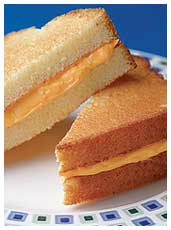
Food historians generally agree that cooked bread and cheese combinations [in many different forms, textures and tastes] were ancient foods known across most continents and cultures. The earliest recipes for food like these are found in Ancient Roman cookbooks. Modern grilled cheese sandwiches descended from these ancient recipes. Welsh rarebit, cheese fondue, focaccia, pizza, and mozzerella sticks are all variations on the same theme.


Who invented the grilled cheese Americans know today? We will never know, but we can (given the ingredients) place it in time. Culinary evidence suggests our modern grilled cheese (consisting of processed cheese and sliced white bread) began in the 1920s. That's when affordable sliced bread and inexpensive American cheese hit the market. Goverment issue cookbooks tell us World War II Navy cooks broiled hundreds of "American cheese filling sandwiches" in ship's kitchens. This makes sense.

The sandwich was economical, easy to make, met government nutrition standards AND (if done right?) quite tasty. In the 1940s and 50s these sandwiches were open-faced and usually made with prepackaged grated "American" cheddar cheese. It wasn't long before school cafeterias and other institutional kitchens followed suit. The usual accompaniment? Tomato soup. At that time, tomato soup would have been perceived as a healthy dose of Vitamin C. Excess sodium was not an issue.


By the 1960s, the top piece of bread became standard. The reason is not clear. Possibly? This was the least expensive way to make a popular sandwich more filling.


Some people wonder about the difference between toasted cheese and grilled cheese. Are they the same thing? On the surface, recipes for both produce somewhat similar results (melted cheese nestled between two slices of crisp, warm, buttered bread). Actually? Food historians tell us this a linguistic puzzle. Notes here:


"Toast...is made by placing a slice of bread in front of dry heat-a fire, a grill, or an electric toaster...Certainly, toast has a long history in Britain. Tost was much used in the Middle Ages, being made in the ordinary way at an open fire...Often toast was spread with toppings...Meat toppings for toast became fashionable in during the 16th century...Towards the end of the 16th century all knds of things began to appear on toast....[including] melted cheese."


---Oxford Companion to Food, Alan Davidson [Oxford University Press:Oxford] 1999 (p. 796-7)


"Grill...to cook by direct exposure to radiant heat, as in when a piece of meat is placed on a grill...The North American word for the verb grill is broil."
---ibid (p. 354)


A survey of American cookbooks reveals that recipes titled for "toasted cheese" sandwiches predate those titled "grilled cheese." Grilled cheese shows up in print in the 1960s. BUT!!! It is also apparent that most recipes for toasted cheese sandwiches were broiled (what the English term grill). To further complicate matters, there seems to be little or no relationship between the name of the dish and the instructed method of cookery.

Heating methods include toasting in a broiler, baking in a oven and frying on a cooktop with a frying pan, griddle or similar device. It is interesting to note one does not find recipes for "fried cheese sandwiches," even though many of the recipes called for this cooking method. Curious, yes?

Foodtimeline.org

Labels: ,


Today.com